
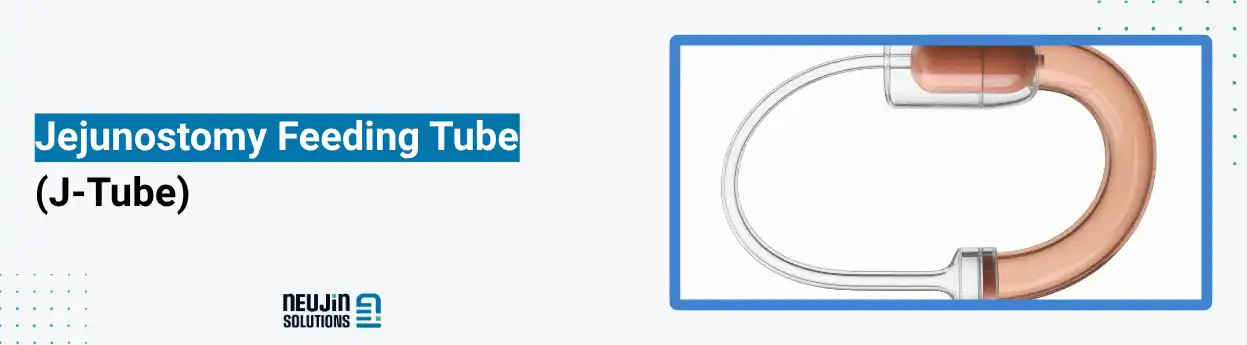
An enteral access device delivering nutrition directly into the jejunum for patients unable to tolerate gastric feeding or oral intake.
What the Device Does
1. Long-Term Access
Provides stable access to the small intestine for enteral nutrition, hydration, and medications.
2. Bypasses Stomach
Used when gastric or oral routes are contraindicated due to severe reflux, gastroparesis, or high aspiration risk.
3. Nutritional Support
Maintains or improves nutritional status whilst bypassing the stomach and proximal duodenum.
How It Works
1. Placement
Tube is placed surgically, endoscopically, or radiologically through the abdominal wall into the jejunum, creating a stoma.
2. Retention
Internal retention device (balloon or moulded bolster) and external fixation plate maintain position securely.
3. Delivery
Distal tip delivers formula into jejunal lumen via pump-driven or gravity enteral feeding sets.
4. Confirmation
Correct placement confirmed through fluoroscopy or endoscopy, maintained by securement and routine care.
Types of Jejunostomy Feeding Tubes
| Conventional J-Tube |
| Surgically or endoscopically placed with internal balloon or bumper and external retention disc. May be dedicated jejunostomy or jejunal limb through gastrostomy tract (G-J tube). |
| Low-Profile/Button J-Tube |
| Short, skin-level devices with low-profile external port and internal retention device. Often used for long-term paediatric or adult home enteral feeding. |
| Transgastric-Jejunal (G-J Tube) |
| Placed via gastrostomy stoma, advanced so distal limb terminates in jejunum. Enables gastric decompression with jejunal feeding. |
FDA Classification
| Class II Device |
| Regulated under 21 CFR 876.5980 as “Gastrointestinal tube and accessories”. |
| 510(k) Required |
| Requires premarket notification with performance, biocompatibility, and bench data. |
| Product Codes |
| FPD (tube, feeding), PRY (gastrostomy-jejunostomy feeding tube kit), and related Gl tube codes. |
FDA 510(k) summaries confirm J-tubes and transgastric-jejunal devices as Class II under the same regulation, requiring performance, leakage, tensile strength, patency, radiopacity, and connector compatibility data.
EU MDR Classification
1. Class IIb
Under EU MDR Annex VIII, J-tubes are invasive, long-term devices channeling enteral nutrition via artificial opening.
2. Rules 5 and 8
Classification based on invasiveness, duration, and potential for serious complications.
3. Documentation Required
Annex VIII rule-based rationale supported by clinical evaluation and PMCF.
Key Product Standards
| ISO 20695:2020 | ISO 80369-3:2016 | Supporting Standards |
| Enteral feeding systems design and testing. Specifies requirements for enteral feeding catheters terminating in stomach, duodenum, or jejunum. | Small-bore connectors for enteral applications. Defines unique enteral connectors (ENFit) to avoid misconnections with IV, neuraxial, or respiratory systems. | ISO 80369-1 (general connector requirements), ISO 10993 series (biocompatibility), ISO 11135/11137 (sterilisation), plus ASTM methods for performance testing. |
FDA and EU MDR Classification Table
| Device Type | FDA Product Code /Regulation | FDA Class | EU MDR Class (typical) |
| Jejunostomy feeding tube (J-tube) | KNT, 21 CFR 876.5980 | II | llb |
| Gastrostomy-jejunostomy feeding kit | PRY, 21 CFR 876.5980 | II | llb |
| Low-profile transgastric-jejunal tube | KNT/related Gl codes, 21 CFR 876.5980 | II | llb |
EMDN and GMDN Codes
| Jejunostomy Feeding Tube | Transgastric-Jejunal Tube |
| EMDN: G02020203 – Jejunostomy, tubes and sets | EMDN: Same jejunostomy/GJ-tube cluster |
| GMDN Code: 38564 | GMDN Code: 38564 |
| Term: Jejunostomy tube | Term: Jejunostomy tube |
| A thin, flexible tube placed into the jejunum through an artificial opening in the abdominal wall for enteral feeding. | Used for G-J devices in many UDI listings; specific subcodes depend on design and kit composition. |
Disclaimer: Device classification, standards, and nomenclature must always be confirmed against the latest FDA databases, EU MDR Annex VIII rules, MDCG guidance, and current EMDN/GMDN releases for specific intended use.
Need Help with Your Application?
Standards Mapping
Mapping to ISO 20695 and ISO 80369-3, building GSPR matrix.
Risk Management
Focused on misconnection, leakage, migration, and infection risks.
Clinical Evaluation
PMCF aligned with Gl access device risks, predicate selection for 510(k).
Regulatory Support
EMDN/GMDN mapping and harmonised labelling for “enteral only” use.
Contact us for support in any of the above areas.