
What Are Bone Plates?
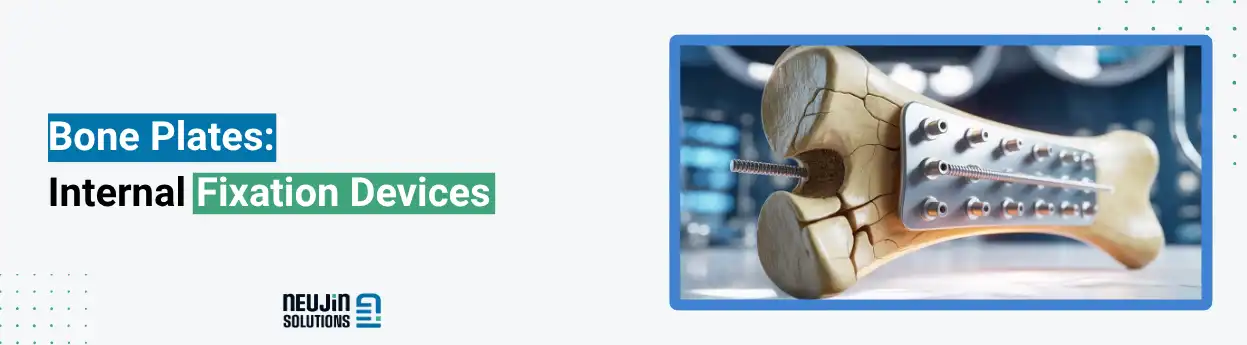
Bone plates are metallic implants that stabilise fractured bones during the healing process. They function as internal splints, secured to bone with screws.
These devices provide rigid support against bending, shearing, and rotational forces, maintaining proper alignment whilst natural callus formation occurs. The plates transfer loads across the fracture site, creating optimal conditions for bone regeneration.
How Bone Plates Work
1. Contouring
Surgeon shapes the metallic plate to match the bone’s anatomical profile for precise fit.
2. Positioning
Plate is positioned to bridge the fracture site, aligning broken bone segments accurately.
3. Fixation
Multiple screws secure the plate firmly to healthy bone on both sides of the fracture.
4. Load Transfer
Device bears mechanical forces whilst natural bone callus forms and strengthens over time.
5. Healing
Bone regenerates under stable conditions; plate may require surgical removal post-healing.
FDA Regulatory Guidance
1. Non-Spinal Plates Guidance
Orthopaedic Non-Spinal Bone Plates, Screws, and Washers – Premarket Notification (510(k)) Submissions
Updated November 2024 for Industry and FDA Staff
2. Performance Pathway
Orthopaedic Fracture Fixation Plates – Performance Criteria for Safety and Performance Based Pathway
Guidance for Industry and FDA Staff addressing performance requirements
These guidances provide comprehensive frameworks for demonstrating substantial equivalence and meeting performance criteria for bone plate submissions
Material Standards
1. ASTM F136
Titanium-6Aluminium-4Vanadium alloy for surgical implants
2. ASTM F138
Stainless steel bar and wire for surgical implants
3. ASTM F1537
Wrought cobalt alloys for surgical implants
4. ASTM F67
Unalloyed titanium for surgical implant applications
These standards specify chemical composition, mechanical properties, and biocompatibility requirements for implant-grade materials used in bone plate manufacturing.
Performance Testing Standards
| Plate Testing | Screw Testing |
| ASTM F382: Static bending strength | ASTM F543: Comprehensive screw testing including drive torque, axial pull-out, and self-tapping performance |
| ASTM F384: Dynamic fatigue resistance | |
| ASTM F3437: Locking mechanism performance | |
| ISO 9585: Mechanical testing protocols |

These standards ensure devices withstand physiological loads throughout the healing period, typically 3-6 months under cyclic loading conditions.
Classification Overview
EU MDR Classification
Class llb
Long-term surgically invasive implant under Rule 8 Duration exceeding 30 days in body, requiring conformity assessment via Notified Body route.
FDA Classification
Class II
Typically under Orthopaedic Panel Various product codes; requires 510(k) premarket notification demonstrating substantial equivalence to predicate devices.
Important: Final classification depends on intended purpose, duration of use, invasiveness, and whether device is active. Always reference Annex VIII + MDCG 2021-24 guidance
Key Regulatory Considerations
1. Standards Scope Review
Carefully review applicability of each standard to your specific device configuration, material selection, and intended use before claiming conformity.
2. Classification Anchoring
EU classification cites Annex VIII rules, but final determination requires assessment of intended purpose, contact duration, invasiveness level, and active/non-active status per MDCG 2021-24.
3. Predicate Selection
For FDA 510(k) pathway, identify appropriate predicate devices with similar technological characteristics, intended use, and performance specifications.
How We Can Support Your Application
1. Standards Sanity Check
Verification that selected standards appropriately cover your device scope and testing requirements
2. GSPR Documentation
Pre-filled General Safety and Performance Requirements tailored to your bone plate specifications
3. Risk Management File
Comprehensive ISO 14971 compliant risk analysis and management documentation
4. Clinical Evaluation Report
CER development meeting MDR Annex XIV requirements with appropriate clinical data
5. Predicate Device Selection
Identification and analysis of suitable predicates for your 510(k) submission strategy
6. PMCF Survey
Post-Market Clinical Follow-up study design and implementation for ongoing surveillance
Ready to Navigate Your Regulatory Pathway?
Whether you’re preparing a 510(k) submission or pursuing EU MDR compliance, expert guidance ensures efficient regulatory approval.
Contact us today: Drop us an email or send a direct message to discuss your regulatory strategy.
Found this helpful? Share this carousel with your regulatory affairs network and tag someone who needs this guidance.